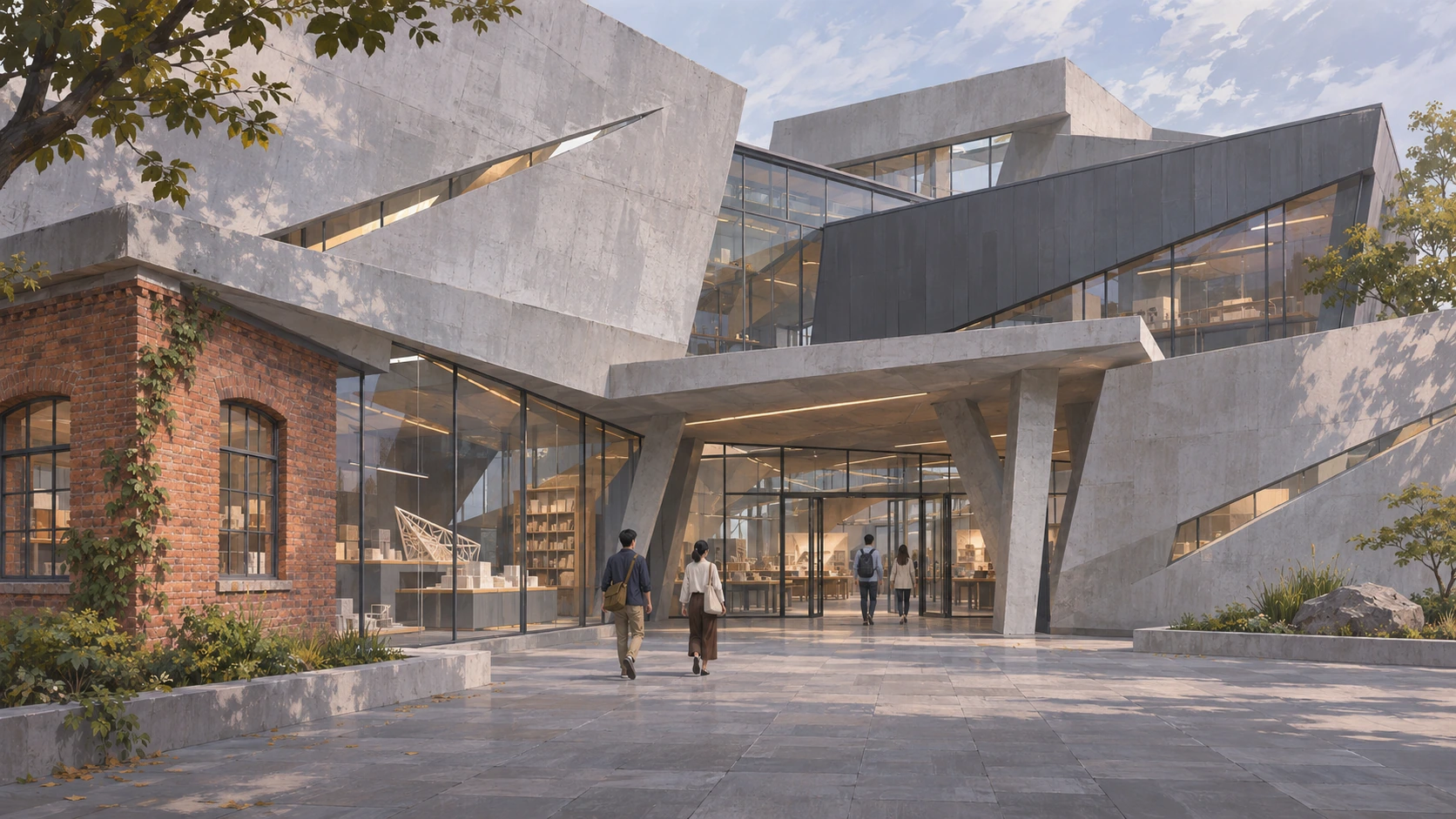
60Deconstructivist Architecture
Let displacement, cuts and intersections create tension within a legible whole.
Definition and context
Deconstructivist architecture can reorganize a familiar whole through displacement, intersection, cuts and visually unstable relationships. MoMA's 1988 exhibition offers a specific historical view. Publicly available images of Gehry and Hadid projects allow further comparison, without making every curved, tilted or irregular building part of one category.
People and ecology
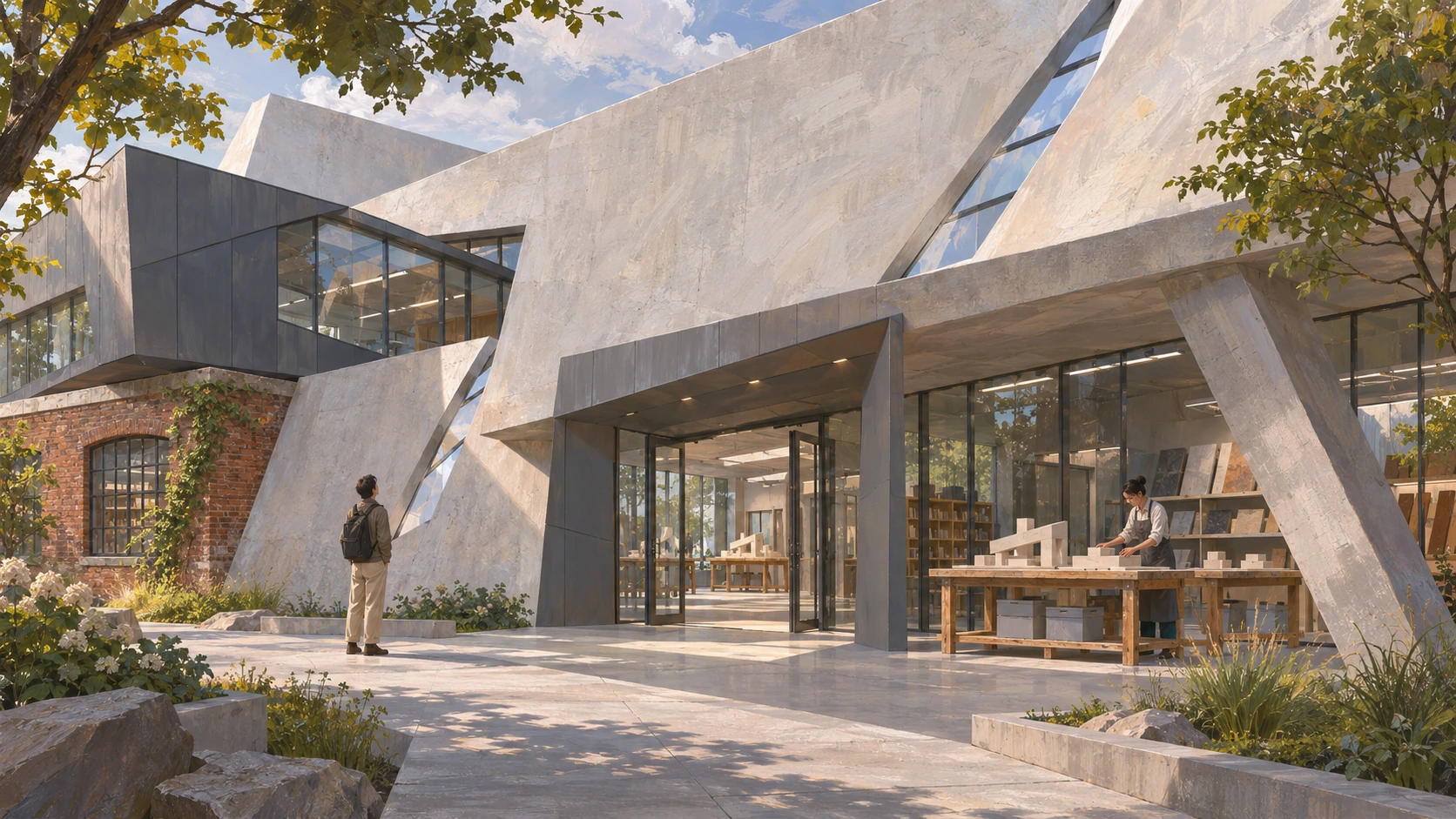
People entering, turning and crossing thresholds on stable ground let formal tension coexist with clear use. Ordinary plants can retain natural growth directions against different architectural axes. Bodies need not be arbitrarily tilted, and a sense of falling is not the only way to create unfamiliarity.
Spaces and forms
Establish a recognizable whole before choosing displaced volumes, cut surfaces, conflicting axes or separated layers. Local changes should remain traceable to overall relationships rather than randomly accumulate sharp corners. Entrances, floors, supports and routes still need identifiable places.
Color and materials
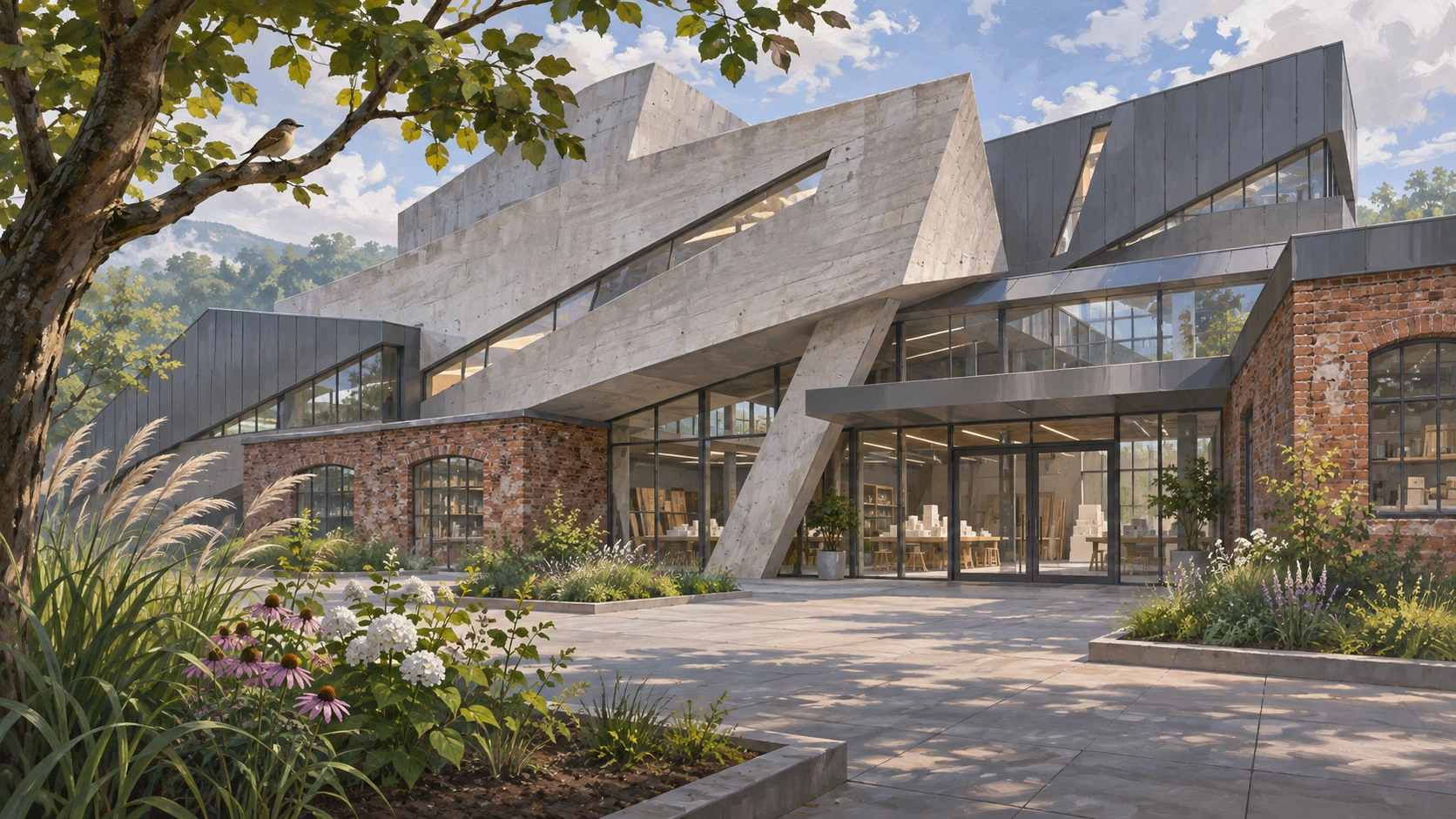
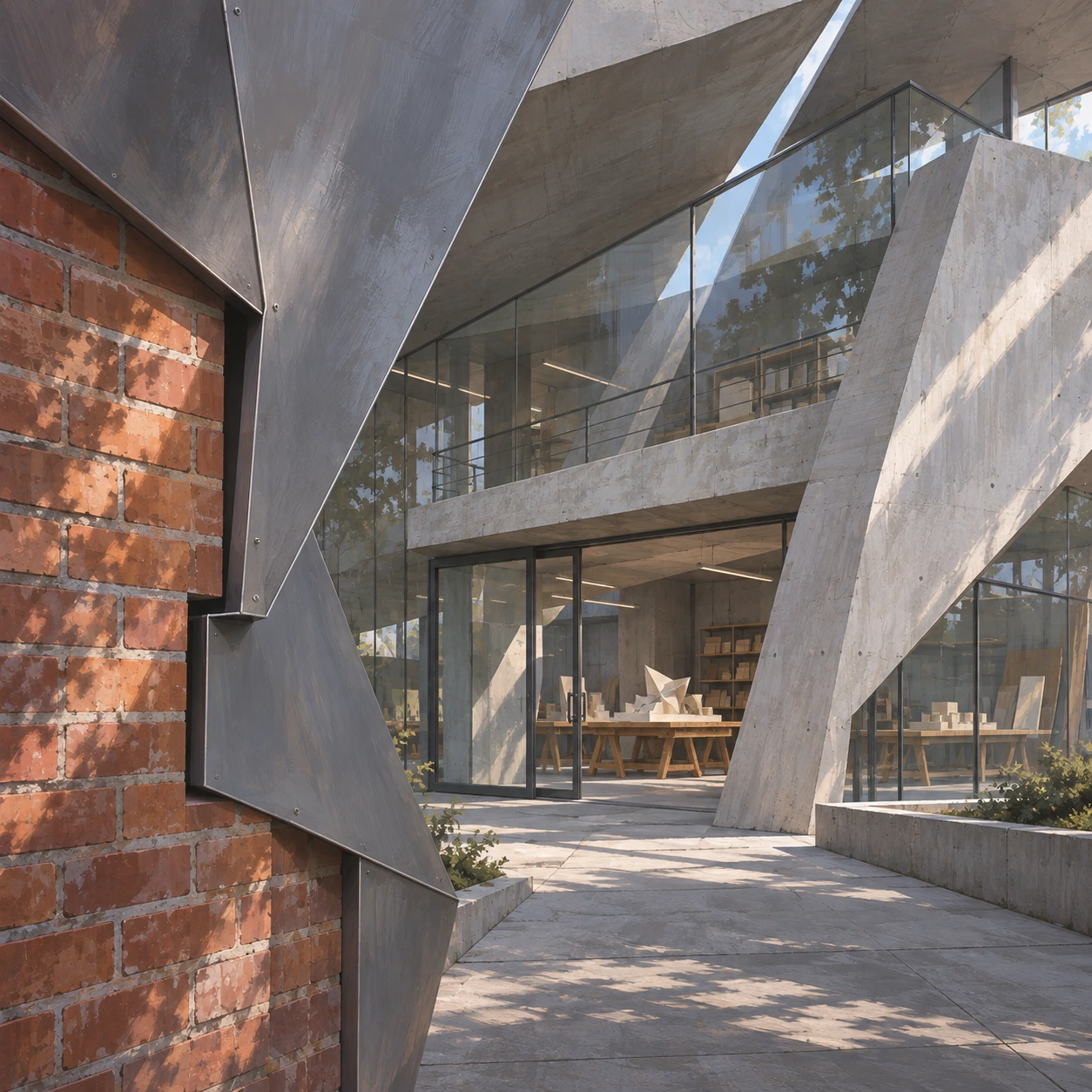
Metal, concrete, brick, glass and other materials can meet through joints, folds and layers. Keep old and new, solid and skin, transparent and opaque legible. Continuous curves may participate without turning every building into the same crumpled metal surface.
Light, composition and scale
Side light and clear shadows can reveal intersections, while narrow openings admit light along different directions. Establish hierarchy with a few large forms before adding small gaps. Complexity does not require equal emphasis everywhere; a stable background can sharpen displacement.
Sound and graphics
Interaction can reveal hidden joints and openings from different positions or take one level route through differently aligned spaces. Sound changing between adjacent volumes can aid orientation. Visual instability need not impose incomprehensible or unwalkable movement rules.
Motifs and distinctions
Compared with postmodern architecture, this category emphasizes relationships between wholes, fragments and axes rather than necessarily quoting classical elements. Unlike impossible architecture, tension need not violate gravity or create a spatial paradox. Organic curves and associations with life are also optional, unlike the focus of biomorphic abstraction.
Ideas for game environments
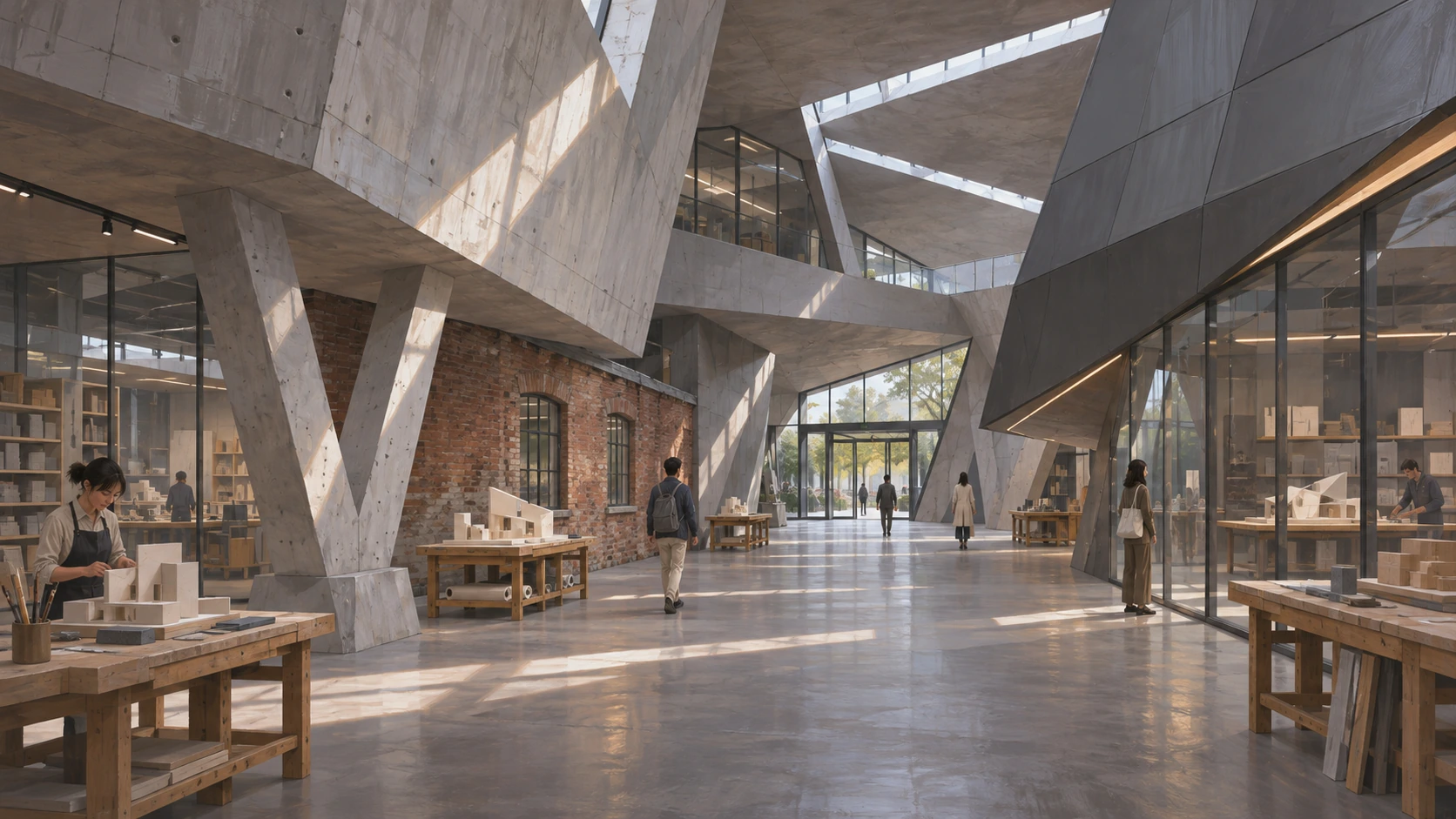
Design a materials-and-models workshop building. A stable level path crosses displaced slab-like volumes, an old brick block remains distinct from new metal and concrete layers, and diagonal light slots reveal intersections. Ordinary worktables and visitors establish scale, supporting complex form with clear use.
Read scene descriptions
Main environment
An original materials-and-models workshop carries a stable level path through displaced slab-like volumes. An old brick block, new metal skin and concrete cuts remain distinct as diagonal light slots and ordinary worktables connect complex axes with clear use.
Stable ground and ordinary actions provide a baseline for different axes.
Natural plant growth contrasts with cut and displaced building boundaries.
Folds, joints and layers keep relationships between old and new materials legible.
A level route crosses different axes while complex forms retain clear uses.