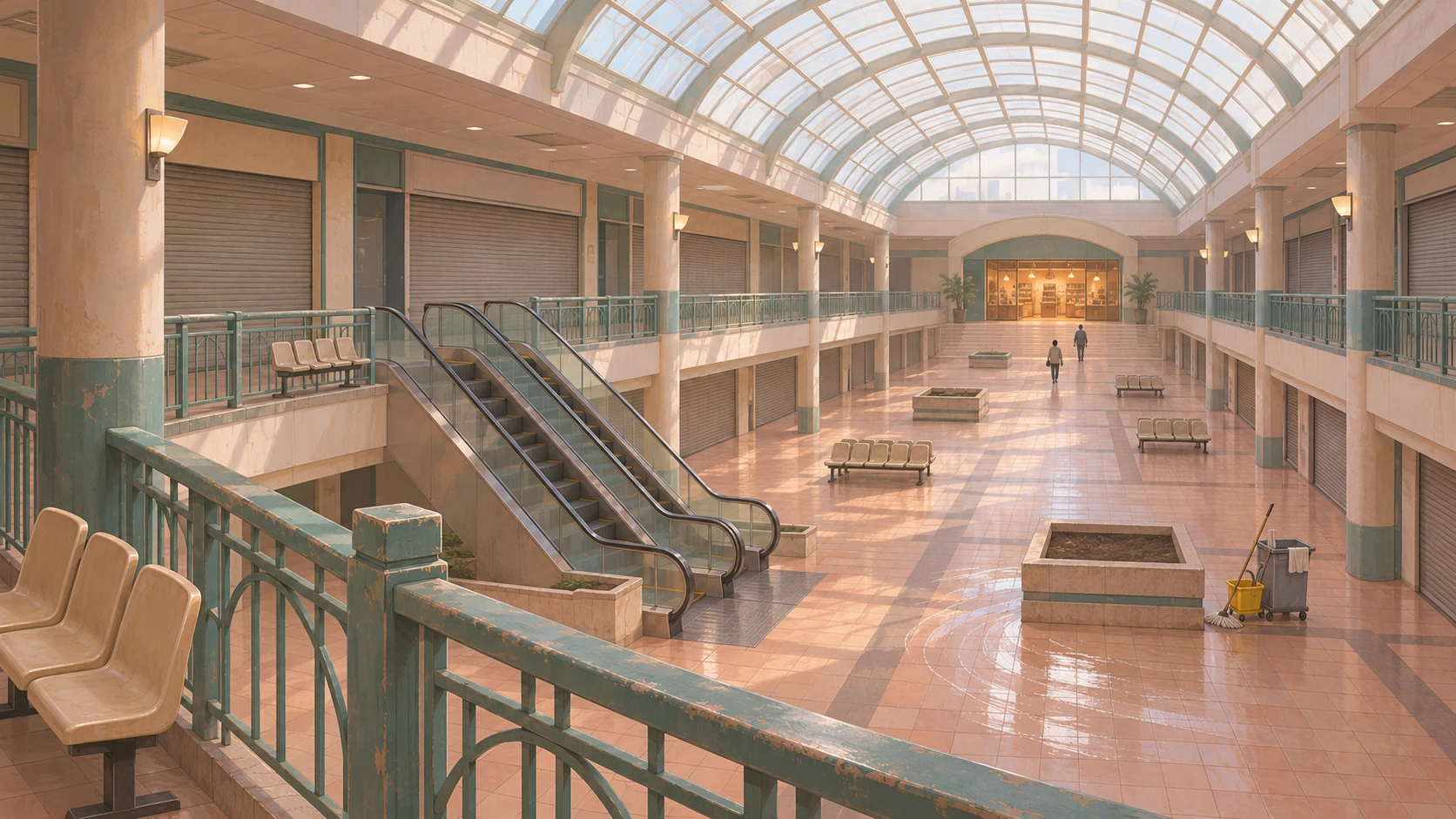
35Mallsoft / Dead Mall Imagery
The space remains prepared for crowds that no longer arrive.
Definition and context
Mallsoft is primarily a musical direction associated with vaporwave; dead-mall imagery is a related spatial motif rather than an interchangeable term. Disconscious's Hologram Plaza supplies a concrete music-and-cover reference, while Dan Bell's public documentary previews offer architectural clues. These original illustrations study sparse retail space without claiming that historical images show a mall's condition today.
People and ecology
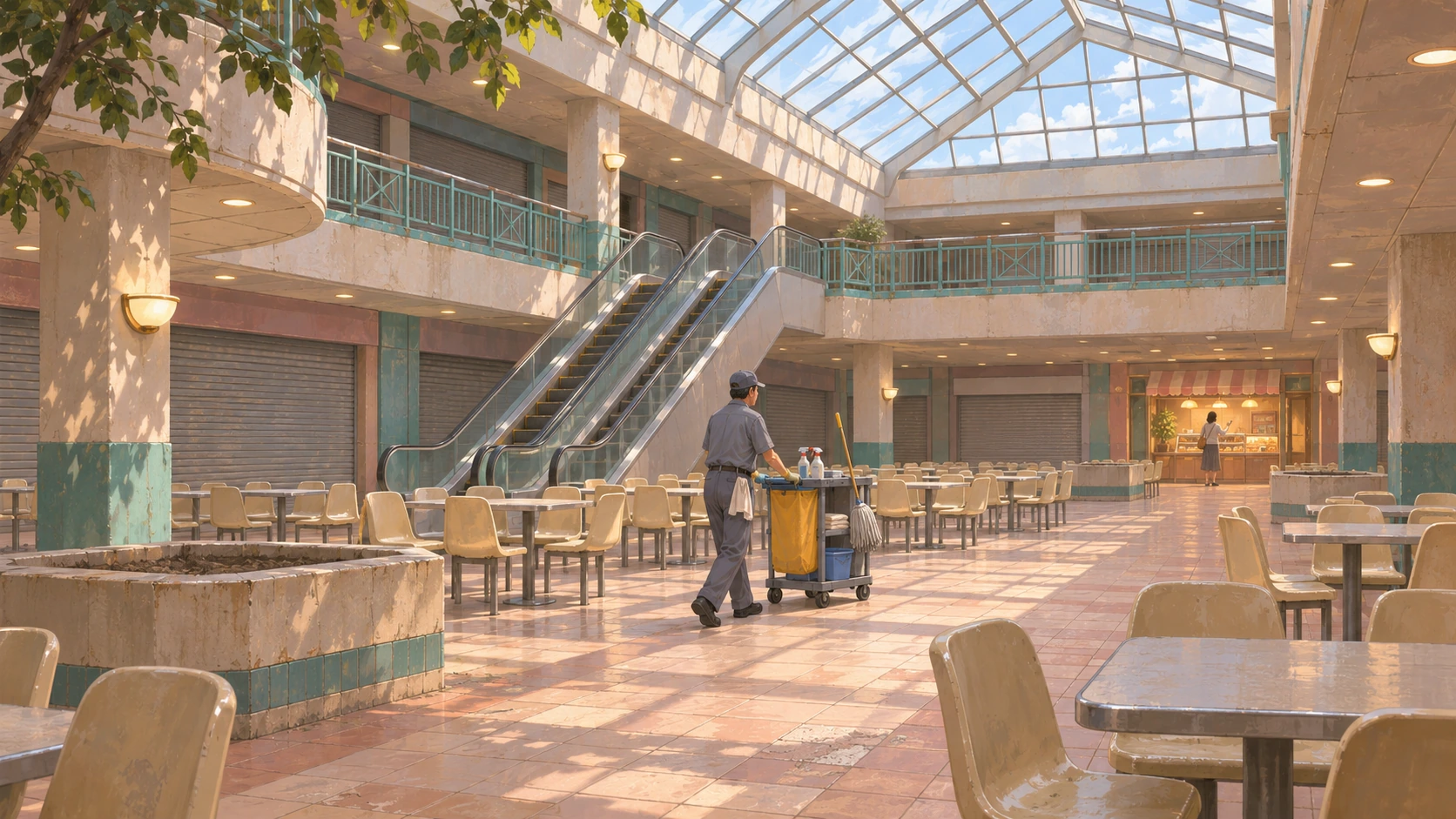
Figures may include a few shoppers, cleaners, small-shop operators or no visible users. Sparse people matter in relation to surplus seats and empty counters. Do not automatically make shoppers ghosts or imply that every declining mall has ceased all use.
Spaces and forms
Atriums, escalators, skylights, repeated retail bays, seating and food courts should form legible circulation. Some vacant units beside a lit shop can express retail afterlife more clearly than total structural collapse. Retain ordinary floor heights and railing scales.
Color and materials
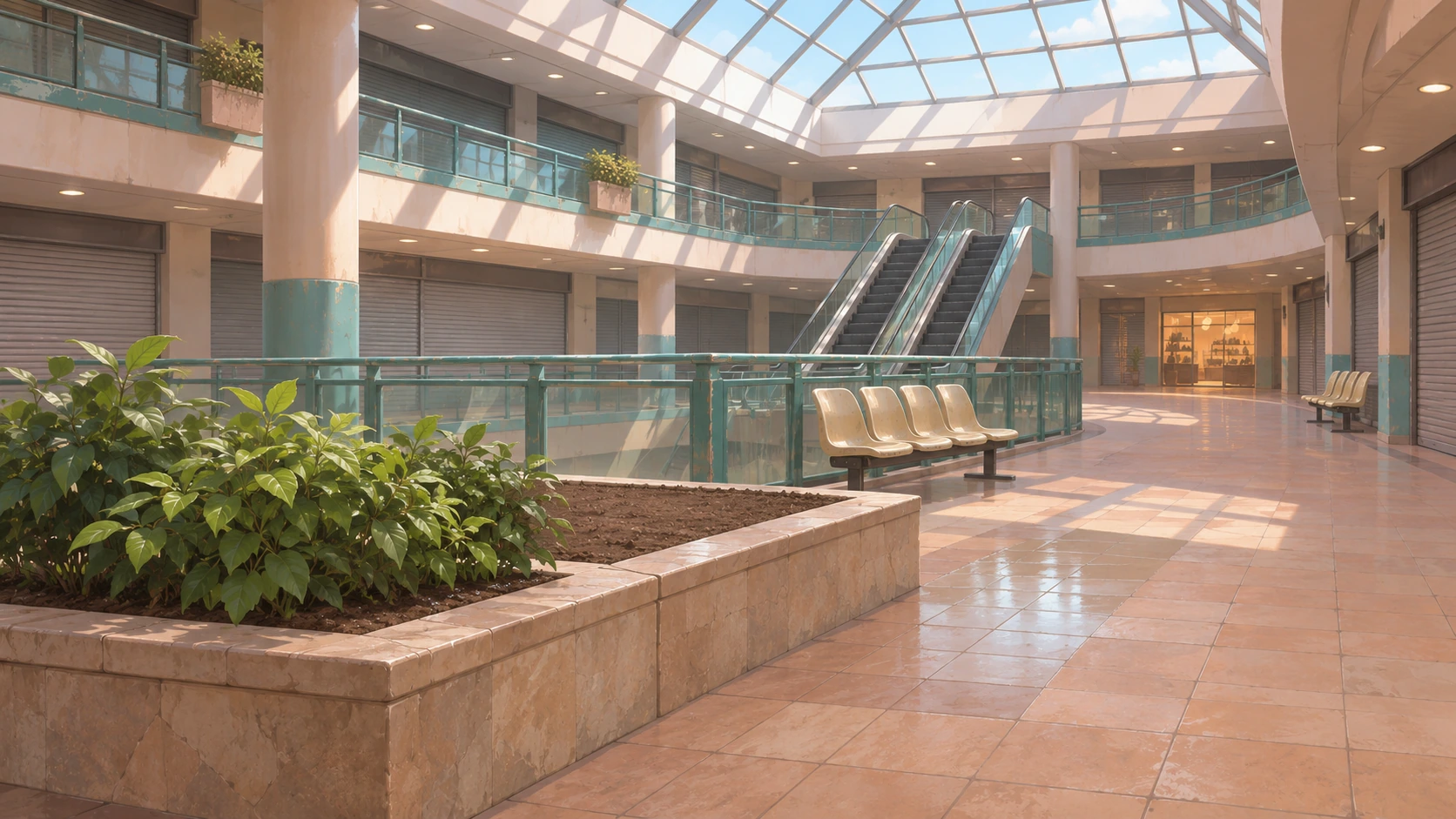
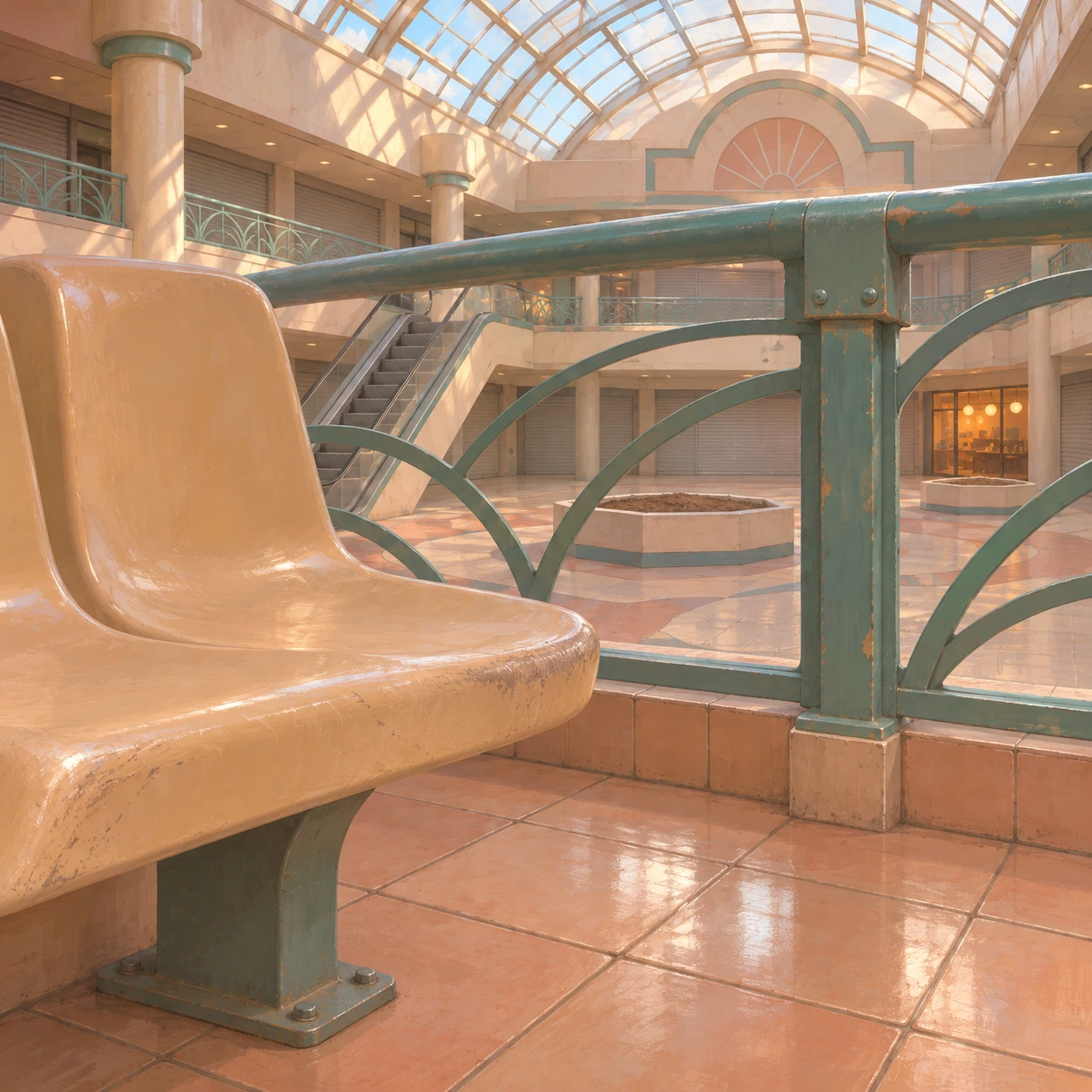
Polished tiles, pastel metal rails, old plastic chairs, empty planters and worn door frames preserve maintained surfaces. Local updates from different periods can coexist. Vacancy does not mean universal decay; selective wear can describe use better than uniform dirt.
Light, composition and scale
Daylight through skylights can coexist with operating retail fixtures. Broad bright floors, empty counters and a distant small light establish separation. Pastel colors or neon are venue-specific choices rather than reasons to turn every mall purple.
Sound and graphics
Distance, repetition and reverberation in music are important references, but a static image can only suggest speakers, volume and source distance. An interactive work might let shop music recede while keeping footsteps and announcements spatially distinct.
Motifs and distinctions
Compared with liminal space, this category emphasizes facilities left by shopping, leisure and consumer promises. Compared with ruin aesthetics, a mall can remain intact and partly open. Compared with broader vaporwave, it concentrates on imagined mall acoustics, routes and reduced crowd density.
Ideas for game environments
Keep an escalator running with few riders. Place a polished bench beside an empty planter. Make the only open shop a destination beyond rows of closed units. Show retail life receding through the gap between maintained details and surplus space.
Read scene descriptions
Main environment
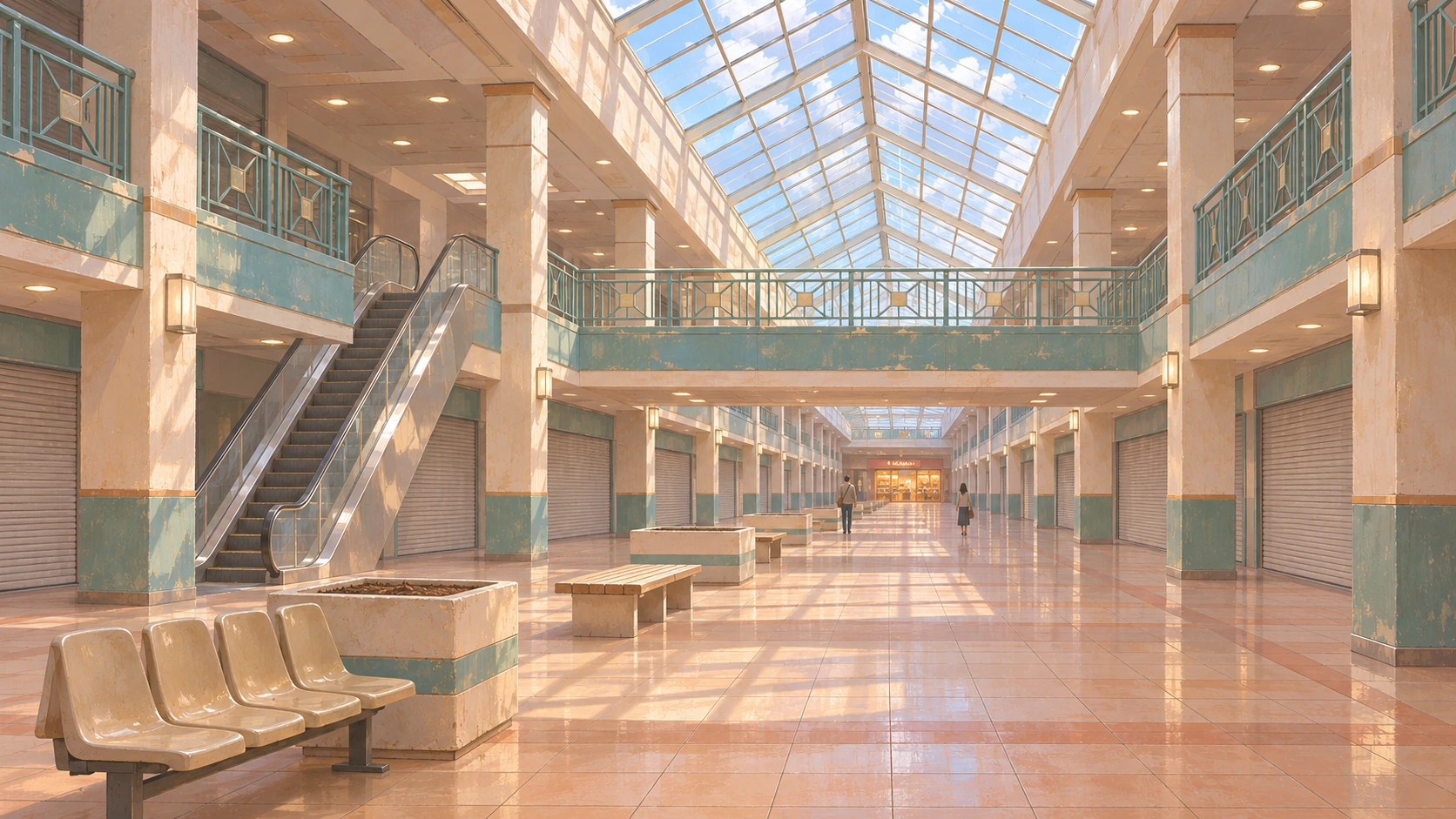
An original mall atrium retains skylights, escalators, old seats and repeated shopfronts. Most units are closed while one small shop remains lit; sparse visitors and maintenance traces reveal surplus space.
Sparse figures and surplus seats reveal a loss of crowd density.
Maintained plants and empty planters retain different states of use.
Selective wear on tile, plastic chairs and metal rails describes time.
A few lit shops preserve retail circulation among closed units.